
Education FAQs
Below are a handful of the most commonly asked questions I have received from parents and students over the past decade and a half.

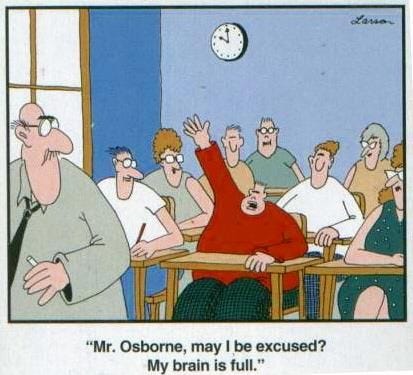
If parents are the most important factor in their children’s education, what chance do my children have? I didn’t get a good education; how do I give my children what I lack?
As a parent you don’t need to know everything and none of us do. In fact, many parents with great educations help their children too much and thereby inhibit them. What you should seek to do is something that every parent, regardless of their education, can do: hold your children accountable and create an environment conducive to learning.
My Dad left school somewhere between 8th and 10th grade, I’m not exactly sure when. He couldn’t help me with my homework, but he expected that I do things and do them well. Time and again my Dad, who hauls cattle for a living, would say “if you are only going to do that half-[heartedly], then you may as well quit school. I don’t give a [care] one way or the other. But right now, you can either stop complaining and get your work done and get it done well, or you can get your [butt] outside and shovel the cow [manure] out of my trailer.”
Ultimately it is the student that determines the quality of education that they receive—even the best teacher is merely a facilitator. So if you hold your child accountable, if you make it unquestionably clear that they will do their work and will do it well, they will learn.
The second thing you can do is create an environment conducive to learning. If you didn’t get a good education, then start now and learn alongside your kids. Read books together. Discuss what you or they are learning. Don’t make a mindless screen the center of your home, but rather put your television in the basement or in an out of the way room. Have screen free times, days, or even months. Get outside. Get active. Go on walks, go to parks, draw with chalk, jump rope—don’t just sign your kids up for an activity, ship them off, and delegate their leisure to “professionals”; be active and engage with them yourself. Play games. Talk with them. Do goofy things like karaoke and laugh together. Tell jokes. Do crazy impressions. Cook together. And then linger over your meals. Pray together. Study God’s word together. Sing hymns together. Watch documentaries or thoughtful movies you can discuss. Travel to places of historical importance or natural beauty. Visit museums. Ask you parents or grandparents to share stories of their childhood. Have friends over. Make your kids play outside—they will come up with great things to do! Education is a lifelong endeavor and not something contained within the four walls of a school. There are many things you can do to allow education to happen organically in your home.
Helping your children receive a good education by keeping them accountable and creating an environment conducive to learning is hard, but it is rewarding. The same is true of everything in life! Is not marriage hard, yet rewarding? Is an easy, mindless job rewarding? No, challenging jobs tend to be more rewarding. The level of value in a thing is generally commensurate with what you have to sacrifice to attain it. Keep that in mind as you sacrifice your comforts to help your children get a good education.
Why do I have to study things I will never “use”?
To answer this we need to consider what a person is and what they are made for. If a person were just a body, then the goal of education would be to develop that body, extend its life, and find ways to make the body have a pleasant time on earth. Anything that didn’t further this would be pointless. There might be a place for virtue, but only so far as it helped one get ahead—otherwise the goal would be advancement over others and the accumulation of wealth and power to provide one with the comforts one desires.
But man is not just a body, he is a soul as well. As such education will involve a number of things that train the soul. But the soul isn’t a slab of marble—one can’t work on it directly. One cannot, for example, simply instill within oneself the virtue of perseverance. One has to *wait for it* persevere through things to develop perseverance!
Something like math is going to be directly used by an engineer, but it will no less benefit a seamstress or a poet. For in studying math one learns to think through things logically and to be successful at it one must develop habits of concentration, diligence, and perseverance, habits that will benefit one in any vocation and in all areas of life.
But can’t one learn these habits another way? For example, can’t one learn concentration, diligence, and perseverance by playing piano instead of studying math? Indeed one can! I don’t believe there is any such thing as one “right” educational path for all people. If the goal of education is the formation of the soul, then there are multiple ways to go about it. Jesus never studied Calculus or Physics and yet He was The fully-formed Man. So would I support a young person that wanted to forego math so that he or she had time to master the piano? Given the right circumstances, yes. But the fact of the matter is that most students that want to get out of studying math (or any subject) generally don’t want to do something else of value and difficulty, rather they want to do nothing or something of negligible worth.
I think the very question “why should we study things we will never use?” is mistaken. To begin with, no young person knows what they will end up using. And secondly, and most importantly, a person is not a thing to be trained! A person is more than their accumulated skills, so education must be more than the mere transmission of skills and useful knowledge.
Should Sports be a Part of School?
I clearly remember a conversation I had with a group of upperclassmen over a decade ago. One of the girls was explaining the way that the varsity basketball team captains “punish” the team after a loss. In short, on the bus ride home they would enforce a strict silence on the team: no talking, no texting, not even any reading or homework allowed. They enforced these 1-2 hour silent bus rides in the hope of motivating their teammates to play better. This was done with the express encouragement of their coach.
I thought at the time, and I still think, that this exposed a fundamental misunderstanding of what sports are for; a misunderstanding that is inexcusable at a Christian school. The goal of sports is not to merely win—anyone that competes only for the sake of winning will find victory shallow and defeat devastating—the purposes of sports seem to be something like:
1) Having fun! Sports are games after all!!!
2) Promoting physical fitness.
3) Promoting friendship/comradery/teamwork.
4) Helping one to learn to be gracious in victory and unbroken in defeat.
I’m sure there are other things one could add to this list, but I think these are the main things that sports, rightly done, encourage.
Why is this understanding important? If we have an understanding of what sports are for, then we can know if the way we are engaging in them is beneficial or detrimental. For example, if I engage in a sport in such a way or to a degree that it undermines my physical fitness (for example, it makes me too tired to do my job or spend time with my kids), I need to rethink it. If I am so competitive that I come to hate the people I compete against or my teammates when they let me down, that is, if the way I engage in a sport undermines, instead of promotes, friendship, I’ve lost view of what it is for and it has become sinful.
I played high school sports and I have many found memories of them—pushing myself and others to run faster or play harder and winning hard fought games. But I also remember lots of laughing, practical jokes, and lots and lots of euchre on long bus rides. I have few distinct memories of losses, but many memories of my teammates. I do not think I would look back on those times half as fondly if every loss we had was followed by enforced silence.
Judging the effectiveness, or even the goodness of a thing, by its purpose is helpful for not only sports, but for everything! What are the goals or purposes of marriage? Only when you have these in mind can you have a clear idea of what parts of your marriage might need work and how you can best address them. What are the goals or purposes of English grammar or History? Only when we have these in mind can we fairly judge what texts we should choose, what types of assignments are valuable, how we should assess our students, etc.
To answer the original question, “should sports be a part of school?” we simply need to ask: “do the goals of sports and school overlap? Is there a place in school for games that encourage physical fitness and friendship and that help students to grow in character?” Absolutely. There might be logistical limitations that prevent a school from being able to offer sports, but I do not think there is any philosophical problem with offering them, and indeed there are many benefits, so long as the proper goals of sports are understood and pursued.
Should Christians attend secular or Christian colleges?
*Important note*: What I write here is far more speculative than what I normally write, so please keep that in mind as you read.
I remember a strange class during the end of my last year in Law School. My professor was a partner at a prominent law firm, but he also had a PhD in English and a Master’s in Theology. His expertise, and the work he was teaching us, was Bonhoeffer’s Ethics. I don’t remember the context that prompted his rant, but he said the following. ‘You all think your education is complete now and that you have learned a lot. But you have learned nothing. Absolutely nothing. . . . I take that back, you have learned some things that are worse than nothing—you have all learned deconstructionism and moral relativism. That’s it. And you swallow those false philosophies whole because they were dressed up as “critical thinking”. But none of you have learned critical thinking, none of you even know what that even means. You’ve all been given a crap education, but it has been hidden by the fact that moral permissiveness is not judged, but rather encouraged, and most of you are too young to feel or recognize the consequences of living a libertine life. The Roman Emperors of old disguised the lost liberty of their subjects with bread and circuses; we hide the lack of a truly liberal education by plying beer, hookups, and big-ten football. My advice to you all is to recognize that you are completely uneducated and to seek to become learned men and women. Law School trains you to be mere clerks because we don’t have a legal system built for free individuals; our system is a decadent and Byzantine. We teach you to be clerks to navigate this labyrinth, to do the types of things a talking chimpanzee could be trained to do. Don’t settle for that. Become a learned individual. College did nothing for you, but don’t let that get in the way of leading a learned life.’
That stuck with me. And while I don’t agree with everything he said, there was some truth in it. I think his critique is especially true in the humanities. I think of a student that loves Jane Austen and goes to college to study English Literature. There is a good chance that this student will be taught that Jane Austen had a “false consciousness” and that the only thing one can learn from her books is how oppressed women were by marriage and how men concocted a system of morality to keep women in subjugation and that Austen, unfortunately, was unable to overcome this system but instead held to and propagated it. In short, the student will learn absolutely nothing about Austen, but only that his or her professor reads her books through a Marxist lens. But not only will the student learn nothing, their enjoyment of Austen will undoubtedly be diminished as will their appreciation of Austen’s wholesomeness, wit, and insight. I don’t know the extent to which Humanities departments are dominated by ideology, but I do know there is far greater opportunity for ideology to completely take over in the Humanities than in math or science departments or the trades.
I think an even greater problem than ideology is the moral permissiveness that is accepted, and even encouraged, at many secular colleges.
I went to a concert at the Memorial Union during the summer with my teenage daughter and we saw a number of young ladies that were dressed unchastely to a degree that I am not sure I have ever witnessed before. Human beings are formed profoundly by our communities, and I can’t help but think how living in that environment would influence my daughter. When we talked about it she said things like, “that is gross and I would never dress like that.: And I told her that it is easy to see this clearly after being in an environment for only two hours, but much more difficult after being in the environment for multiple years. Things that seem odd, gross, and even wrong soon seem normal with familiarity.
People are always growing and developing; they are not machines to be programmed, so there is no right “code” that we all need to enter. Some people that go to secular colleges go wild and rebel against their Creator, others grow immensely in the face of opposition, and still others muddle through, neither losing their faith nor growing and spend years after their graduation struggling to put the pieces together. Conversely, some people go to a Christian college and grow immensely under the direction of wise and godly teachers, while others feel like they are being force fed their faith and come to hate and reject it.
When thinking through what is best for my children I hone in on two questions: (1) what does my child want to study? Is it something that is likely to be dominated by ideology in a secular education setting and therefore end up, at best, being a complete waste of time? And (2) does my child have the maturity to live in a morally permissive environment where drunkenness, recreational drug use, and sexual immorality are the norm? When thinking through this second question I consider: are there strong Christian communities around to help Christians live faithfully in the midst of the secular university they are interested in? I personally would be very hesitant to send my children to a secular university that did not have a strong church or parachurch ministry that he or she could join.
Is virtual learning a viable substitute for in-person learning?
Like so many things, it depends. In this case it depends on what one means by “learning”. If a person is mature and well-formed already, then I think it is fairly easy for him or her to appropriate virtual teaching for his or her continued self-education. But I think it is different for young people.
The virtual education model often assumes that the student is a passive object to be filled, not a subject to be known and loved.
Education is formation and it is therefore much more akin to discipleship than programming. And education is comprehensive, so it ought to be lived out in a comprehensive relationship—it should not be reduced to information giver and information receiver, rather it should be mentor and mentee, led by a teacher that cares for the student and with a student that knows and respects the teacher. In many cases virtual education reduces parents to bill payers and kids to computer hardware. Can it be good in some situations? Absolutely. But is it equivalent to in-person learning? No.

How important is it for a teacher to have a teaching degree?
It is my opinion that the way we use credentials in our society is often silly. I think of the scarecrow from the Wizard of Oz. ‘I have a degree, so now I have brains.’ I have worked with and observed over a hundred teachers—some have had master’s degrees, some have had teaching degrees, and a few didn’t even have college degrees. In my experience there is very little correlation between the degree one has and one’s ability to teach. It is not that credentials are bad in and of themselves—they represent training and one’s ability to see something through, both of which are good! They can be especially helpful for a new teacher. But there are many poor teachers that are highly credentialed and many good ones that are not credentialed at all (one of the single greatest teachers I know never attended college).
One of the biggest problems with relying on credentials is that we’ve democratized higher education.1 In short, we have created a higher education system in which virtually anyone can get a higher degree. This is not bad in itself, but in order to make higher education accessible to everyone we have watered-down acceptance and graduation standards.2 As a result, success in higher education, at least in some fields, often doesn’t come down to innovation, creativity, or even ability, but rather passivity and completing one’s time.3
I would love to see the development of apprenticeships. When I think about education in particular, it is my conviction that for many teaching positions (though not all) two years in a classroom working alongside a veteran teacher and studying educational theory and one’s subject matter would better prepare one to teach than a four-year degree.
Ultimately, like nearly everything, the most important indicator of success is not one’s credentials or even one’s knowledge, but rather one’s character. If a person is defensive when confronted with an area of growth, if they lose their temper with students, if they are lazy, if they don’t follow through, if they give up when things are tough, their degree is irrelevant and they will fail in their job at a critical moment.
Do Contemporary Schools Favor Girls Over Boys?
Before discussing this, I think it is important to note that (1) boys and girls are different and therefore learn differently and (2) anytime one moves toward one group of people one moves away from another group. Let me take a moment to unpack the second statement. Consider a pastor. To clarify a passage of scripture a pastor might give an example from marriage. The second he does this he is talking to married folks and not to single people. Likewise, he can give an example about dealing with a tough manager. The second he does this he is talking to employees and not to employers. There is no way that his examples will equally reach all people. Given this, in some sense he is “favoring” the groups that he speaks more often to or about, but it does not follow from this that the other groups cannot learn from these examples.
That being said, over the past few generations schools have moved to deemphasize competition in the classroom (e.g. we don’t publicly post grades after each exam!) and towards more cooperative and group activities, they have moved to spoken languages, like Spanish, and away from written languages, like Latin, and they have moved away from aggressive physical games (like rugby) to co-ed recreational games. Every child is unique, so nothing said generally is true for every child, but *in general*, these changes have favored and benefitted girls and in some cases they have harmed boys’ development and education.
As a result of these changes, and many other societal changes that I don’t have time to unpack here,4 “Women now outperform men academically at all levels of school, and are more likely to obtain college degrees and enroll in graduate school.”5 If we start with the premise that boys and girls are equally capable and see the result that girls are far outpacing and outperforming boys, it is logical to conclude that the current system favors girls over boys.
Given this fact we need to be looking for means of helping boys in ways that don’t hurt girls. There are probably four thousand different things we could do, but I’ll limit myself to four:
Students should spend more time outdoors. This is good for everyone, but being active outdoors seems to help boys disproportionately.
Allow for more physical activities during recess and gym class. Girls naturally talk in a circle during recess; boys never do this. If left to themselves, they will wrestle and climb, etc., but because of our overweening concerns for safety, we prohibit a number of activities that have been beneficial to the development of boys that they have done for millennia.
Encourage more men to work at schools. Education isn’t just information transfer! Boys need models and mentors and men are not proportionally represented at schools.
Encourage training in the trades.6 There are many boys that want to work with their bodies that are forced to sit indefinitely in their seats.
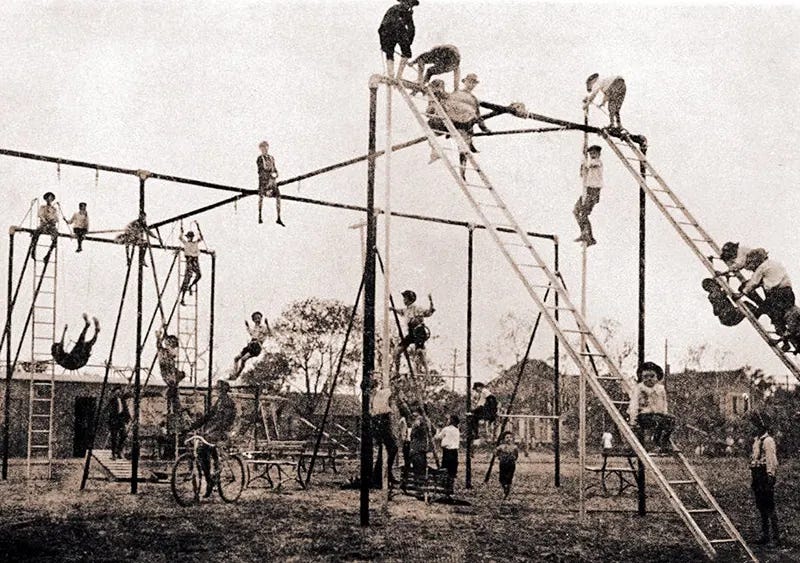
I came across this photo years ago when I first started teaching. This school encouraged risk-taking, strength, and the overcoming of fear and pain—qualities that help to produce entrepreneurs, hearty workers, rugged farmers, etc.
Compare that with the following guide:

This approach sends a different message. Not only does it foster chronic anxiety,7 it sends the following message to an adventurous boy: there is no place for you here.
It is difficult to write about this because everyone sees policies related to differences between the sexes as a zero-sum game. As a result, anything said in favor of helping boys or men is viewed as a desire to harm or oppress women. I think that is a poor and false way of viewing things. It is good to lift women up! But some of the ways we have done this have pushed men down. We can see men and women as equal, but different, and pursue changes that help one without harming the other.
Why do Christian Schools so Often Struggle?
There are two dominant models in Christian education right now: (1) Christian schools that are funded by the state via vouchers and (2) schools funded by attending families. Think of how different both of these models are from most Christian ministries! I know of no other Christian ministry where success or failure hinges on the ministry’s ability to procure state funds or to effectively marshal the resources of the people being ministered to (and this latter scenario is often true even of schools that are connected with churches).
What is more, unlike other ministries, Christian schools have to compete against a state-funded monopoly and they have to do so with far fewer resources (e.g. they often offer no benefits and pay their staff half to a third what their counterparts make at government-operated schools). Despite these disabilities, they tend to produce better results across the board, from test scores to student behavior, etc.
Christian schools exist to carry out the great commission; they are Christian ministries that partner with parents and churches to disciple the next generation. It is my judgment that they are one of the most effective ministries around as well as one of the least supported. What is more, I have found that many teachers work significantly more hours than many in other Christian ministries and they often do so for less pay.
The Church, in failing to see and support Christian schools as ministries, has in effect forced them to choose between seeking state funding or limiting their ministry to those with the means to pay for their ministry. *Important note*: I don’t think either of these are wrong. I have helped schools obtain funding both privately and from the state. I believe both models can be good. But I am convinced that the long-term flourishing of Christian education will require the support of people in the Body of Christ outside of those directly participating in and benefiting from it—vouchers are politically precarious and it is very hard for families to cover the full costs of educating their children.
Support for Christian education should not take away from support for one’s local church, but if one is looking for an impactful ministry to give to, I think Christian schools are some of the best ministries to support.
Read C. S. Lewis’s “Screwtape Proposes a Toast” and “Democratic Education” if you want to explore this idea further.
There is another sector in which passivity is a virtue and in which one succeeds, or “graduates” out of, simply by completing the time assigned to them by various governmental authorities. . . . .
Though this topic is beyond my expertise, it is fairly obvious that for decades our society has devalued manual labor, which has harmed men in general and a specific type of man in particular. We made the choice that it was preferable to have cheaper manufactured goods than to have manufacturing jobs in this country and therefore outsourced countless manufacturing jobs. We disproportionately encouraged the immigration of manual workers, which pushed down wages in the trades and construction and discouraged men that are naturally drawn to those fields. This in turn has affected men’s ability to get married and start families and thereby contributed to the increasing numbers of men that are dropping out of society. Seeing that there is no place for them in society, they drop out of school. I love learning! But it feels borderline abusive to try to teach high-level science, math, and literature to young men so that we can push them towards white-collar work when they have no aptitude or desire for them and to simultaneously deprive them of meaningful manual work that they desire to do and that would allow them to provide for a family.
This probably requires a retooling of our economy so that there are viable jobs for people that are trained in the trades.
Jonathan Haidt writes about playgrounds in The Anxious Generation. While I have learned from him, I gave a talk on masculinity in our culture 12+ years ago in which I discussed playgrounds. I don’t say this to self-promote, but only to mention that I am not stealing this observation from him without giving him due credit.
Are there recommendations you have for homeschooled children? The values and practices you’ve covered in both articles align with many homeschooling principles and yet it’s not been mentioned as an option.