
Builders & Barbarians
What we can learn from the fall of Rome

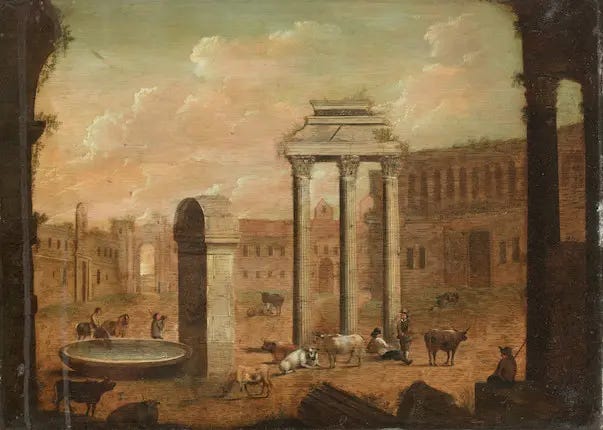
Peasants grazing their cattle in the Roman Forum circa 1650.
362 years before Christ, a great chasm opened in the Roman forum. It continued to grow and grow, threatening the continuance of the city. Augurs proclaimed that the pit would not close until Rome cast its most precious treasure into it. The Romans threw gold and jewels, silks and even swords into the chasm, but still it continued to grow. As despair increased, Marcus Curtius realized that Rome’s greatest treasure was not a “what”, but a “who”—the Roman people. He outfitted himself in his armor, mounted his horse, and at a full gallop cast himself straight into the chasm, which immediately closed.
This is an old legend, but the Romans took it seriously—a plaque from the 1st century BC marks the spot where Curtius plunged into the chasm:
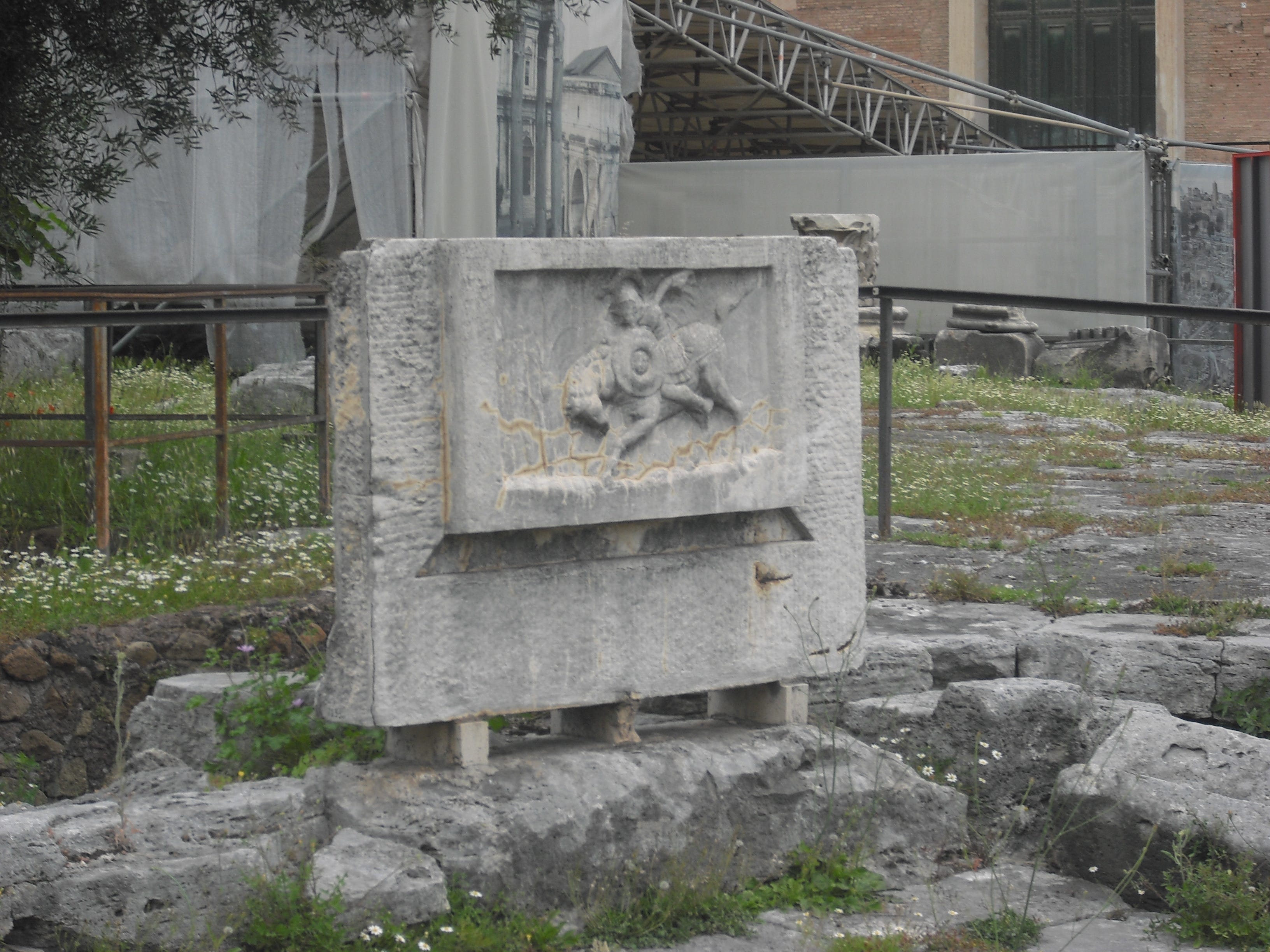
This legend demonstrates the Romans’ mentality. It was this mentality that built their empire,1 an empire which is humanity’s single greatest achievement.2 Romans sacrificed their wealth, their comfort, their interests, even their lives for something bigger than themselves. They also operated with meekness and justice, which led others to trust them.
Rome’s dominion grew because they were Builders: producers, protecters, and providers; Rome fell because they were overwhelmed by, and themselves became, Barbarians: parasites that took and tore down.
Building Rome
Sacraficial devotion. When the Romans overthrew their despotic king in 509 BC, neighboring king Lars Porsena recognized that republican government was a threat to kings everywhere and therefore declared war against Rome in the hope of reestablishing monarchy. Rome was besieged and, as is common in besieged cities, plague took hold and decimated them. Gaius Mucius Cordu (later and better known as Scaevola) asked permission to sneak into the camp of Porsena in order to assassinate him. He was granted permission by the Senate and proceeded to infiltrate the camp. He arrived on pay day and the king and his secretary were paying the soldiers one by one. Scaevola, disguised as a soldier, got in line, but he couldn’t figure out who was the king and who was the secretary and he knew it would be fatal to ask anyone. When he approached them, he stabbed the man he thought was king. It turned out to be the secretary and Porsena immediately had him bound and told him he was going to have him burned to death. Scaevola looked Porsena in the face and told him he was just as prepared to die as to kill. To show the king how bravely Romans suffer, he thrust his right hand into a nearby fire and let it burn without flinching (this is how he got the nickname Scaevola, which means “lefty”). Porsena, impressed by his bravery, gave him his freedom. Scaevola in turn told the king that 100 youths had all pledged to assassinate him and that they would not rest until he was dead. Fearing the bravery and devotion of the Romans, Porsena withdrew his troops. Scaevola’s sacrificial devotion to his city had saved it.
Meekness. In 458 BC Rome was both plagued by civil unrest and was sorely pressed by a neighbor. In response, the Romans appointed Lucius Quinctius Cincinnatus as dictator, a six-month office with absolute power (e.g. the power to execute someone without a trial). Cincinnatus reluctantly took power, defeated Rome’s enemies, and restored peace before his office expired. People worried: how would he use absolute power after the crisis was resolved? Cincinnatus laid down his power and returned to his fields.3 Power was given to him to serve the Roman people and now that they were served, there was no need for him to continue in this office. This is meekness. Meekness is not weakness, but rather the proper use of power. Political power is given to serve the people, not the holder of power, and Cincinnatus demonstrated this perfectly.
Justice. While the Romans were besieging the town of Falerii in 394 BC, a schoolmaster determined to betray his town to General Marcus Furius Camillus. This schoolmaster taught the boys of the leading citizens. Every day he would take them on a walk around the walls for exercise. One day he led them into the Roman camp and told Camillus that the leaders of the city would surrender to spare the lives of their boys. Camillus was disgusted by his treachery and refused to win in such a way. He stripped the man naked and had his students whip him back into Falerii. The leaders of Falerii were so impressed that they voluntarily surrendered to the Romans, preferring the government of such just and honest men to their own rule.
Self-sacrifice, meekness, and justice—these are the virtues of Builders and these virtues made Rome great.
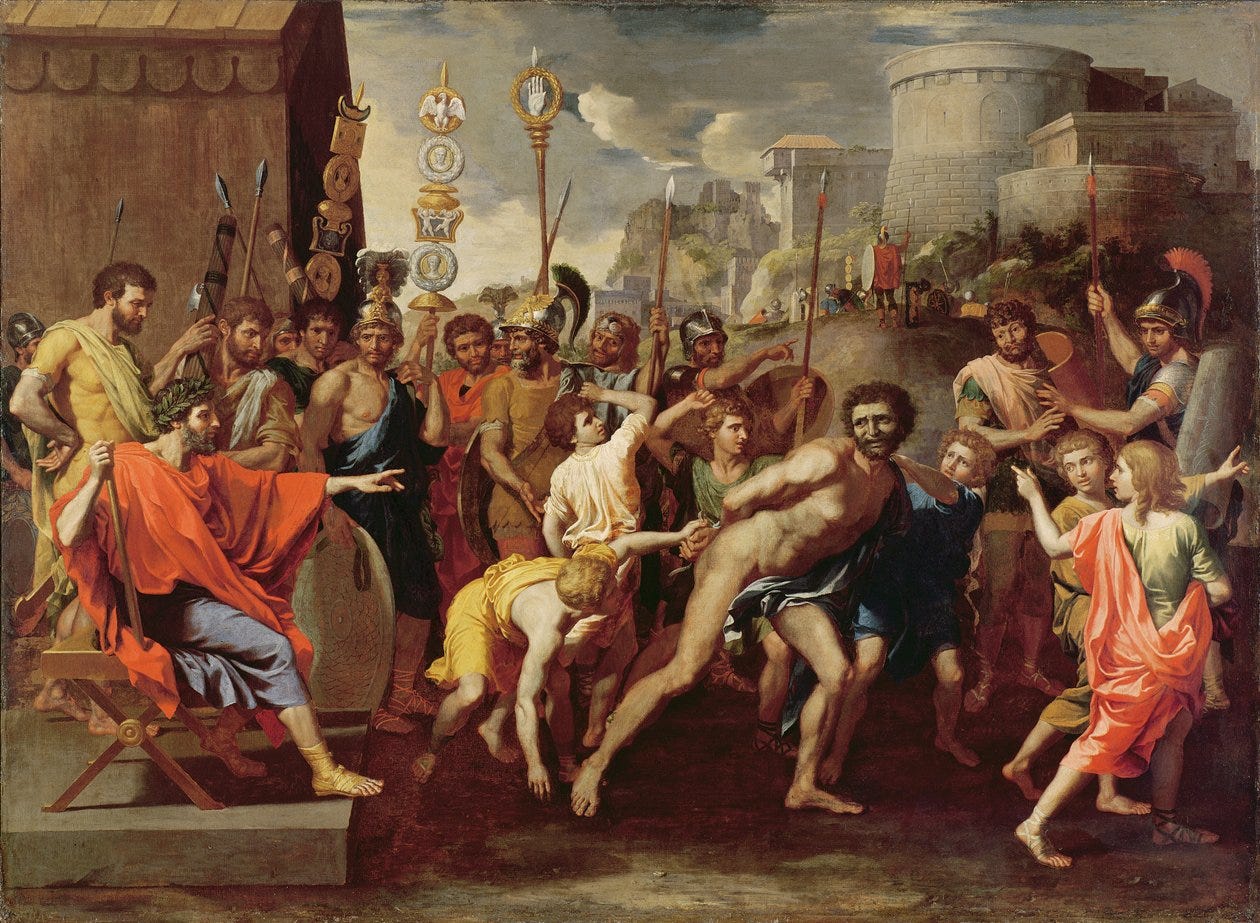
Camilus and the schoolmaster
Why did Rome fall?
The fall of Rome is a multi-faceted, multi-centuries long story and any summary I attempt to give here will be woefully inadequate. But the very, very short answer is that Barbarians invaded Rome and took it over. They did not invade Rome to destroy it, they wanted to be a part of it, but the way they engaged with Rome destroyed it. The virtues of the early Romans created a legacy that lasted for centuries, but as the Romans rejected those virtues, as they took as much as they could instead of continuing to Build, they too contributed to the downfall of their state.4 Indeed, had they retrained their original virtues no host of Barbarians would have been able to conquer them.5
Rome became a place where:
Citizens refused to fight and mercenaries that lacked loyalty to Rome had to be hired.
Roman soldiers robbed the people instead of fighting invaders because unarmed farmers are much less formidable than Barbarian hordes.
Generals engaged in seemingly endless civil wars as they sought to gain imperial power.
Emperors set wages and prices and tied people to the professions of their parents to create social stability.
Barbarians invaded or immigrated on massive levels, seeking to enjoy the fruits of the empire without embracing the virtues that built it.
The rich evaded taxes, emperors debased currency which led to inflation—ultimately, those in power wanted the trappings of power, but not the responsibility of protecting and providing for the people. Those that had once built Rome had themselves become Barbarians—people doing nothing more than taking what they could get from it.
Building America
Every schoolchild learns (or at least they used to learn) how Nathanael Hale declared before his execution, “I only regret that I have but one life to lose for my country.” What many Americans don’t know is that this quote was originally attributed to Cato, a Roman statesman and general.
Like Rome, American greatness was not built on the type of merciless conquest exemplified by someone like Temüjin, but by the sacrifice, meekness, and justice of our ancestors.6
Less than half the Pilgrims that settled in Massachusetts survived their first winter, yet every survivor refused to return to England, so important was the right to worship according to conscience to them. Meek leaders like George Washington laid down power not once (after the war), but twice (after his second term as President). Just men like John Adams destroyed their political careers to avoid unnecessary wars. America had a strong foundation, which has allowed us to not only survive but flourish for centuries. This ethos could still be discerned in the early 1960s when John F. Kennedy declared to our youth, “Ask not what your country can do for you, but what you can do for your country.”
From Builders to Barbarians
Tacitus wrote of the Germans “[They do not want to farm because] to them it seems always a slow and lazy process to accumulate by the sweat of your brow what you might win at once by the shedding of blood.” This is Barbarism: a taking instead of producing; a preying upon instead of protecting.
There are a number of Barbaric movements in the United States:7
We have teacher unions that seek their own interests above those of their students.8
Insurance agencies that find loopholes to avoid covering costs that people have spent years faithfully paying premiums in order to receive.
Likewise, we have people defrauding insurance agencies.
Companies put additives into our food and chemicals into our air and water to increase their profits and then hide behind the complexities of the legal system.
Consumers use products recklessly or dishonestly, seeking a pretext to sue manufacturers.
Large corporations lobby for complex regulations that harm small startups in the name of safety.
Multi-national corporations move production or capital overseas to avoid regulations, taxes, or both.
Farmland is being covered by solar panels and data centers to enrich people in other communities and fuel a consumptive economy, while simultaneously driving up land prices and thereby harming the cohesion of rural communities.
I could give 10,000 more examples, but hopefully this suffices. Our rapidly changing world produces within us a disorienting sense of uncertainty, which leads many of us to connect ourselves to a “tribe” in the hope that it will provide security. As members of a tribe, we magnify the faults of other tribes (as we see them as direct threats) and downplay our own tribe’s faults (because we need it to thrive to keep us safe). In terms of our political tribes, it is my judgement that right now both “sides” massively stink. And we all could better serve our country if we stopped defending nonsense in the name of “it is not as bad as that.”
On the Left we have notable influencers like Hasan Piker openly advocating theft. On the Right influencers like Andrew Tate, who rose to prominence as a pornographer, are teaching young men how to seduce women. Notice that I use “Left” and “Right” as categories and not Liberal and Conservative. The terms Left and Right originated during the French Revolution. During that time both Leftists and Rightists were revolutionaries serving in the General Assembly and both were systematically destroying France’s heritage. They disagreed on methods and specifics, but both contributed to the destruction of France. In the same way, both Piker and Tate are takers, are Barbarians; both are actively destroying our heritage. Unlike Leftist and Rightists, I think there are good versions of both Liberals and Conservatives. Liberals have worked to liberate people from unjust customs and to reform broken institutions—e.g. Liberals like William Wilberforce worked to reform prisons. Conservatives have worked to protect things worth protecting, like marriage via a family wage or the dignity of women by campaigning against pornography. Both Liberals and Conservatives can be Builders; Leftists and Rightists are Barbarians. In my judgement, both Liberals and Conservatives are being subsumed by Leftists and Rightists, hence my conclusion that both “sides” stink.9
Consider the following that I read recently from a tech guy and co-founder of some crypto group:10
“Do you know how hard you need to abuse a mammal to make them not have children? Like, for real? Let’s step back a moment, right? . . . No one’s having kids. And this is across the world. This is across both the West, the East, everywhere it’s happening. . . . Do you know what dating app algorithms do? . . . They don’t optimize for you to meet the love of your life. They optimize for you to keep coming back to the app. . . . Oh, just sell all of our younger generations’ dating lives to corporations for profit. And who pays the cost for this? Who has liability for every person who doesn’t find the love of their life because the whole dating market is [messed] up? Who pays for this? No one. There is no responsibility. It’s completely worthless.”
The breakdown of marriage and family is a global problem. In China, the share of young women with “no desire for children” increased from approximately 5 percent in 2012 to 47 percent in 2023(!!!). Indeed, 2023 was a seminal year—2023 was the first time in humanity’s history that total fertility fell below the replacement rate.11
To receive life and wealth and culture painstakingly accumulated over centuries and use it to advance one’s own dreams, own ideals of self-fulfillment, one’s consumptive fantasies from electronics to suburban lawns to Caribbean cruises, but refuse to pass on life to others, what is this but Barbarism?
Marriage and childbearing are declining for many reasons, but, as claimed in the quote above, dating apps are exacerbating some problems of modernity by reducing people to consumers and products. People on the Left defend them because they facilitate sexual promiscuity, which has been a hallmark of the Left since its inception. People on the Right defend them because there is a market for them and they believe the government should let businesses provide people with services that they want. Principled Liberals and Conservatives would both oppose dating apps. These apps are empowering corporations at the expense of the common man thereby making us less free (i.e. less Liberal—liberal comes from liber, the Latin word for “free”) and they are undermining family and marriage, some of the most important things worth protecting and conserving.12
The cost
The challenge is not that we have a bad culture, we have an anti-culture—we have Barbarians on the Left and Right that are both, in different ways, undermining what has been built. Taking and tearing down has become our collective default. And we follow fools because we are living through a disorienting time of rapid technological change, massive movements of people, redefinitions of humanity from what constitutes a family to gender, and we have communicative technology that beams many things, from earthquakes and wars to murders, daily into our lives and homes, giving distant tragedies an immediacy that our ancestors never experienced. Disorientation leads us to seek simple answers and Barbarians on the Left and Right feather their nests by providing them.
But their messages are often non-sensical. Consider the following image:

The LBGTQ movement claims to seek acceptance and inclusion (c.f. all the colors of the rainbow), but the fist is a symbol of force. Why not a gun? Or a nuclear bomb? If they are advocating using force, and not persuasion or cooperation to attain their goals, what is the limiting principle? Seriously, what message does this image convey: we will use force to bring about unity, tolerance, and acceptance? From Rousseau’s Jacobin disciples to the gulags, that approach has a rather dismal history.
Not only do we fall prey to oversimplified, image-based slogans, but we also operate from a place of arrogance and pride that leads us to reject those that give thoughtful, nuanced answers. Decades ago José Ortega y Gassett wrote, “the present-day writer, when he takes his pen in hand to treat a subject which he has studied deeply, has to bear in mind that the average reader, who has never concerned himself with the subject, if he reads does so with that view, not of learning something from the writer, but rather, of pronouncing judgment on him when he is not in agreement with the commonplaces that the said reader carries in his head.”
Our reliance on quick judgments and slogans and lack of discipline in thoughtful analysis leads us to oversimplified (and often erroneous) judgments. Years ago, when I was new to leadership, I had a person confidently tell me that it was clear that I was either incompetent or evil—there was no other explanation for my conduct. I have found that type of interaction to be all too normal. As a leader there are generally extenuating circumstances, but those circumstances involve either confidential information or third parties. A person of integrity will neither divulge what is private nor throw another under the bus to protect their reputation. Instead, like Batman at the end of The Dark Knight, they will absorb attacks from the very people they are serving.
Our propensity to attack and tear down drives a lot of good people out of leadership and it overly hardens those that stay in leadership. If unchecked, leadership becomes dominated by conscienceless egoists that don’t mind being attacked so long as they can benefit from the trappings of leadership.
What can we do?
The obvious takeaway is: be a Builder and not a Barbarian—protect and provide, invest in communities and institutions, commit to friends and family and embrace children, be quick to volunteer and serve and slow to tear down and criticize and absolutely refuse to exploit and plunder others.
Beyond that, we need to grow in our ability to distinguish style from substance. We need to listen to thoughtful individuals that are temperate and that refuse to oversimplify things or provoke our emotions in order to manipulate us for their benefit.13
Relatedly, we need to distinguish between leaders that seek power to serve themselves and leaders that accept responsibilities to serve others.
Christian leadership, being a Builder, requires us to do the right thing and then turn around and love and serve the people that inevitably attack us for it.
Once we identify good leaders, we need to support them. We cannot be effective Builders without good leaders. This does not mean that we follow our leaders blindly or absolutely(!), but we need to recognize that our culture’s inclination, and therefore our tendency, is to attack prematurely and unnecessarily. This is our default. Undermining good leadership leads to bad leadership, and bad leadership harms us all.
Will Durant was a one-time radical anarchist and lifelong socialist.14 After decades of studying history and writing an 11 volume, 10,000 plus page, integrated history of the West from its origins to the Battle of Waterloo,15 he stated that 85% of man’s ability is found in 15% of the population. Humanity flourishes when the virtuous and able lead.16 Barbarians can be leaderless, for it is very easy to take and destroy, but endeavors that serve others and endure have always been led by Builders. If we do not follow Builders, we’ll either fall under the influence of Barbarians or be overtaken by them. Leadership sets the ceiling of the quality of organizations and cultures.
If someone is leading well, their work is draining. If you disagree with a leader, talk to them in person where you can interact as humans, hearing one another’s tone of voice and seeing facial expressions (email is an incredibly ineffective way to share concerns or hash out disagreements). Be principled and humble in your disagreements, clearly stating your position, but also be open to correction (the odds of you being completely right in your critique are close to nil). Don’t increase the burden of leadership and don’t encourage the growth of excessive hardness in your leaders by being quick to attack, quick to jump ship, quick to assume the worst, intemperate, etc. That is how the world acts. If we want to be different than the world *spoiler alert* we need to be different!
Finally, we need to recognize that we pridefully assume that we know more than we do, we focus on and magnify the faults of others instead of seeking to discover and correct our own, and our default state is anxiety and intemperance, which makes both individual and collective Building impossible. We need to seek to develop virtues to counter these vices—we need to be humble and temperate, slow to assume the worst in others, and be led by reason and not our emotions.
Christ is not a cranky old man yelling at us to get off his lawn and follow 200 arbitrary rules; He invites us into His strength, to become more than we are and to contribute to things bigger than ourselves. Barbarians consume and leave smoking ruins behind them; in Christ we can Build things of lasting value.
The Romans had an empire long before they had an emperor. Rome built its empire during its centuries of republican rule. The transition from republican to emperor rule is fascinating, but not something this post discusses.
Cue 20,000 questions: wasn’t Rome oppressive, exploitive, cruel, etc.? Yes, but far less than most empires. Napoleon’s empire lasted two decades; the Roman Empire two millennia. The *second* the Warsaw Pact states could escape Soviet domination, they did; Rome’s neighbors literally fought wars (e.g. The Social War) to join Rome’s political system. The fact that Rome’s political system lasted so long and that people time and against sought to resurrect it (e.g. Charlemagne) shows that it met fundamental human needs better than any other political system created.
Consider Bede’s account from his Ecclesiastical History of the English People. In Book I, Chapter 12 he related how the Britons begged the Romans not to leave. No one ever begged the Huns or Mongols to stay; the Poles did not wish the Third Reich or Soviet Union to endure. The Romans were different than these empires in that they provided real goods, and the Britons recognized that. When the Romans left, Barbarians invaded, “destroying wholesale, slaughtering right and left as men cut ripe corn.” Soon “there was no food left in the whole land except whatever could be obtained by hunting.”
Though Rome provided security and real goods, one could still point out the fact that Rome executed Jesus(!) In The Everlasting Man G. K. Chesterton argued that the point we should draw from this is that the very best thing humanity created was still woefully fallen—the religion that God instituted (Judaism) conspired with man’s greatest political achievement (Rome) to kill the Christ. This doesn’t prove that they were the worst, but rather that even man’s very best is fundamentally flawed and corrupted by sin and in need of salvation.
For a satirical take on Rome’s legacy watch: “What have the Romans ever done for us?”
George Washington was called, and wanted to be known as, the American Cincinnatus.
You can see the contrast between a Builder and Barbarian in the original Gladiator movie. Maximus, the title character, was like many forgotten Romans that held to traditional values even after the Republic fell. Commodus was like many elites that used what others had built to gratify his ego and appetites
Will Durant: A great civilization is not conquered from without until it has destroyed itself within.
What about slavery? To be clear: slavery is immoral—see this post that I recently wrote. Nearly every society has had slaves, so we cannot say that slavery is the decisive factor that produced greatness in America and then not mention the fact that many slave societies have failed to achieve greatness. We need to look to what distinguishes a massively successful state from less successful ones. To be fair, there are probably 130 factors I am not discussing: America’s river system, seaports, metals, distance from Europe, lack of an established church, the Protestant work ethic, etc., etc. There is more I could say, but that doesn’t negate the truth of what I am choosing to focus on.
I’m trying not to be a crabby old man, but rather to objectively, and somewhat randomly, give examples of what I am claiming.
Albert Shanker, former president of the American Federation of Teachers: “When school children start paying union dues, that’s when I’ll start representing the interests of school children.”
I copied this when I read it, but I cannot now track down the original source. Sorry!
While they would both oppose them, I don’t know if either or both would seek to legally proscribe them. There is a big difference between speaking out against something and using the long arm of the state to force it out of existence.
This probably means that we will not seek information from Tic Tac or The Twitter or other such sites that, by their very nature, oversimplify and rely on images to provoke emotions rather than reasoned arguments that require thought.
I mention these details because his study of history led him to conclusions that contradicted his stated ideologies.
It is worth reading!!! I know of no other history that integrates politics, thought, art and the lives of artists, literature, science, social history, etc.
The reader may reasonably be tempted to think that I am being self-serving as I, a leader, write that others need to support leaders. I would ask the reader to re-read the above paragraphs—pay close attention to my assertion that we need to recognize people and ideas of substance and identify leaders of humility and integrity and then promote and support those leaders.